
Continuing education (CE) programs have incredible potential as revenue drivers for associations and credentialing bodies. Too often, though, these programs exist without adding much to the bottom line. In this guide, we’ll outline how to overhaul an existing CE program so that it becomes a revenue-driver in its own right.
Before we get into the how-to, though, let’s take a look at the why: why is now such an excellent time to rethink a continuing education program?
First, demand for certification among workers is increasing:
75% of students agree that they are more likely to enroll in programs that offer micro-credentials for academic credit.
Worldwide, revenue from professional certificates is expected to grow 8.11% per year, reaching a global market value of nearly $9 billion in 2029.
Then there's the employer experience to consider:
70% of US firms report talent or skills shortages. Globally, employers expect 44% of employees’ skills to be disrupted in the next five years, meaning those workers will need new competencies and skills to stay relevant.
Nearly three-quarters of business leaders agree that human capabilities have to keep up with technological advances–but fewer than one in ten think we’re on target to do that.

Clearly, demand for CE is high and only likely to grow as technology becomes more and more disruptive. Here’s why conformity assessment bodies (including associations and credentialing bodies) are the best group to deliver CE and, crucially, how they can craft programs that meaningfully contribute to the bottom line.
Making the Move: When Is it Time to Upgrade Your LMS?
We’ve established that there's a growing demand for continuing education. Now let’s take a look at why associations and credentialing bodies are uniquely positioned to meet that demand, and why doing so can have a positive effect on their bottom line.
There are three related elements to consider here:

Benefit to learners and members

Trust in associations and credentialing bodies

The lifelong learning journey
1. CE Offers an Undeniable Benefit to Learners and Members
Demand for professional certificates is growing as professionals recognize that these certificates have real value for their careers and their professional prospects. To stay relevant in fast-changing industries and amid fast-changing technology, they understand the need to require additional training and certification.
What's more, employees know that earning additional certificates opens them to increased responsibility and higher earning potential at work. On LinkedIn, being able to demonstrate new credentials and certificates may be especially valuable, as it’s possible for anyone (including recruiters) to stay abreast of a worker’s latest achievements.
Then, of course, there are the workers who need to keep their credentials valid or complete CE courses to stay certified.
In all three cases, learners and members recognize CE as a valuable tool to advance and mature in their careers.


2. Learners and Members Trust Associations and Credentialing Bodies
The question then becomes: who will these workers turn to when they’re ready to engage in CE? For many, the obvious first choice is the association or credentialing body from which they got their original certification.
Learners and members trust that the organization that creates and administers an exam or credential is the authority on that subject. They know that no third party is better equipped to develop continuing education assets that align with the certification in question.
Contrast this with how learners or members might see a third party offering CE materials: untested, of uncertain quality, and perhaps only in it for the money.
Beyond the inherent trust that learners and members have in conformity assessment bodies, these bodies also enjoy a kind of “digital trust” that manifests as an ecommerce benefit. When your organization launches CE materials on its website, it is likely to outrank third-party competitors because your domain has more authority for that particular topic.
3. The Lifelong Learner Cycle Means Learners and Members Need You Again and Again
Learners and members know they need CE, and they trust you to deliver it. Here’s where the really powerful part of the equation enters: they’ll need CE again and again throughout their professional career. Just as car owners expect a kind of lifetime maintenance loop for their vehicles, professionals exist in a kind of “lifelong learning loop.”
Understanding this lifetime cycle of learning is an essential part of understanding how CE can become a revenue driver for associations and credentialing bodies. Here’s how it works:
Learn: Learners or members take in new information that will advance them in their careers or keep them accredited.
Practice: At this stage, learners or members practice putting their new knowledge to work via practice questions, mock assessments, self-assessment, and more.
Certify: Learners or members take an exam or test to earn a specific credential or certification.
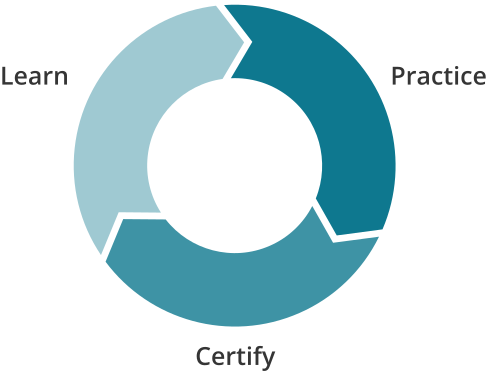
At every stage of this ongoing cycle, learners or members benefit from support from associations or credentialing bodies.
A CE course and practice materials are the obvious examples, but there are many others:


Remaining in continual communication with members or learners offers a very real benefit to your organization: you stay on their radar. This makes it much easier to cross-sell and upsell the various CE courses you offer.
Check out our guide on how to create a lifetime learning journey to foster your learners’ or members’ long-term success.
Clearly, associations and credentialing bodies are well-equipped to provide CE in a way that improves members’ or learners’ experience and drives revenue. Now let’s talk about how to ensure that the content in your continuing education materials is of the quality necessary to keep members or learners engaged and make them eager to return for more.
Keep Your Learners Engaged: How to Create Effective Content
Engaging content helps retain existing members and learners and encourages them to renew. Again, let’s think of that car that needs maintenance throughout its lifetime. Are you likely to return to a mechanic whose diagnoses are questionable, whose shop is messy, or whose fixes never seem to get to the heart of the problem?
Or are you likely to return to the place with a clean waiting room that always has fresh coffee and fast WiFi, where the mechanics explain in detail what's going on with your vehicle, and where you drive away with no new rattling sounds?
Just as important: which service provider are you likely to refer your friends to?
In the world of continuing education, the content of the CE modules is akin to the experience at the mechanic. This encompasses both the material itself and the way learners or members are able to access it. Together, the content and its format must be engaging enough to hold learners when a thousand other content types are pulling at them, from social media to TV to podcasts and beyond.
In this section, we’ll break down exactly how you can do that.
First, though, a quick definition.
Engagement (n): The degree of attention, curiosity, interest, optimism, and passion learners show when learning or being taught, which extends to the level of motivation they have to learn and progress in education
When learners are engaged, the learning (or teaching, depending on whose shoes you’re wearing)
is more effective, which in turn supports key business goals:

Connecting with as many learners or members as possible to increase reach

Bringing in revenue from learners or members who return time and again

Delivering meaningful impact to learners and members, thus demonstrating you share their values

Part 1:
The 3 Components of Engagement
Cognitive: Cognitively engaged learners are able to form connections among ideas. They’re able to think critically about the topics covered in a CE course and put learning strategies to use.
Emotional: Emotionally engaged learners are motivated to participate in courses, complete course material, study, and practice. Their emotional engagement refers to the way they feel about the learning experience.
Behavioral: Behavioral engagement refers to how involved learners or members are in doing the actual work of learning: participating in discussion forums, asking questions in classes, taking practice quizzes, etc.
The strategies outlined in Part 2 address each of these components. For more insight into these components, consider viewing our webinar on How to Maximize Learner Engagement.
part 2:
8 Engagement Strategies for Content and Delivery
To create CE content that engages learners or members on all three dimensions of engagement, try these eight strategies.
Personalized learning
Today, personalization is the norm in the content we consume. From social media feeds to tailored playlists to shopping or viewing recommendations, much of what your learners or members encounter is algorithmically built just for them.
Microlearning
It’s no secret that human attention spans are shrinking, though the reason may surprise you. Abundant information (from 24-hour news cycles, social media, and elsewhere) leads to a fear of missing out (FOMO), which drives us to bounce from one platform to another.
Gamification
Another way to keep CE learners engaged is to gamify the learning process. This is exactly what it sounds like: bringing some element of game play to learning. For example, you might set up a competition to see who in a class can complete the most practice questions. Or let learners score points for contributing in various ways or completing various study modules.

Blended learning
CE learners are busy. They’re juggling multiple priorities, not least of which is the career they’re hoping to advance by completing the CE course.
To accommodate those busy schedules, associations and credentialing bodies can offer a combination of synchronous and asynchronous learning modules, also known as blended learning.

Collaborative learning
Collaborative learning (also called social learning) involves learning with a group. It not only drives engagement but also helps boost retention because the social learning environment lights up more areas of the learner’s brain.

Learning that taps metacognition
Thinking about thinking can help keep learners engaged and improve retention of material. One way to introduce metacognitive elements into CE courses is to ask students to think critically about their study strategies: what's worked in the past? What hasn’t? What will they do this time around?

Course branding
The last thing a CE course should sound like is a history textbook. Why? History texts are often written to sound neutral, which translates to bland.
Instead, aim to give course materials a voice or character. Make sure they have a consistent look and feel, using the same fonts and colors throughout. In some cases, updating only the font and color scheme can breathe new life into course content.

Storytelling
One reason history texts are a bad model is that they tend to over-index on facts, which only tap the cognitive dimension of engagement.
Storytelling, on the other hand, is a great way to engage the emotional dimension as well. Whenever possible, find ways to weave stories into course material to bring concepts to life.
✓ Spotlight: CEO Insights: HRCI’s Approach to Creating Engaging and Effective Learning Content
Part 3:
How to Drive Engagement Before and After a CE Course
Creating engaging, stand-out content for the CE course itself is the main event of creating an engaging CE experience. But for associations and credentialing bodies serious about driving increased revenue via CE offerings, it’s also essential to find ways to engage learners before and after the course itself, i.e., when they’re in other phases of the lifelong learning loop.The tables below highlight ways to tap all three dimensions of engagement both before and after a CE course.
Before a CE Course
The goal of these actions is to promote CE courses and activate learners.
After a CE Course
The goal of these actions is to retain learners and reactivate them – i.e., to get them into another course when they’re ready.
Part 4:
Foster Engagement with Technology and Automation
As with most things, having the right tools makes a big difference in how easy it is to create and distribute engaging CE materials. So far, we’ve mentioned video, email, streaming courses, audio material, ecommerce, text-based materials, and more.
Without the right platform, coordinating all these elements can be challenging.
With the right platform, however, the work of building engaging CE materials that make your organization stand out from the crowd is much more doable.
Not only that, it will feel much more intuitive for your learners. That’s important, because a disjointed learning experience—or even one that lacks basic features learners have come to expect elsewhere, like recommendations for additional practice or a snapshot of their current status—can counteract even the most engaging course material.
While it’s possible to piece together a technology stack to achieve everything we’ve outlined so far, doing so requires much more work on the backend. For example, you’ll need IT resources to make sure the polling plug-in you add to your video streaming service works every time an instructor needs it and can capture poll data and send it to the instructor’s admin portal to guide their next lesson plan.
If you’ve got an IT team that has capacity to manage all those APIs and troubleshoot as connections break, this can be a workable model.
For most organizations, though, the easier and less time-intensive option is to invest in an
all-in-one learning management system (LMS) that includes…
Conclusion: To Grow Revenue This Year, Reinvigorate Your Continuing Education Offerings
Demand for CE is on the rise as workers adapt to a changing professional landscape and stay up to date with the demands of fast-evolving industries. Associations and credentialing bodies have a combination of brand equity, trust from learners and members, and deep knowledge that makes them uniquely well-positioned to meet the needs of this growing market.
To seize this opportunity and translate it to bottom-line growth, organizations can update their CE programs so that they engage learners throughout the learner loop, which will also keep them consistently top of mind.
If you’re interested in starting the process of revamping your CE materials and you’re curious about how BenchPrep’s platform could support you, request a demo today. We’d be happy to show you how our technology makes possible all of what we discussed here.
Take the eBook With You!
Download PDF


